Ultra, the Multi-Alien

Người đăng: vanmai yeu em on Chủ Nhật, 6 tháng 8, 2006

DC introduced a lot of weird characters in the late 1960s, but few of them were weirder than Ultra, The Multi-Alien. Ultra was Ace Arn, a space explorer from the near future, who was accidentally transformed into a freak with the composite powers and body of four different aliens. As was becoming common, some of the conflict in the story was actually internal; the hero was unhappy with being "different". See Ben Grimm (Thing), Metamorpho, the Doom Patrol and others. At first one of the agonies for him was the loss of his girlfriend, Bonnie Blake, but eventually she accepted him despite his strange appearance.

Ultra's powers were pretty basic--he could fly, had incredible strength in one arm, could shoot lightning and had magnetic powers as well. He first appeared in Mystery in Space #103, taking over the cover and feature slot from Adam Strange. There were eight appearances in all, with #110 spelling the end for both the Multi-Alien and Mystery in Space.

More about →

Người đăng: vanmai yeu em


Number 6

Jack Cole and Silver Streak, Part I


It's fun to go back and look at the early work of the really great cartoonists and comic book artists. By the mid-to-late 1940s Jack Cole had risen to a level of comic sophistication with Plastic Man that still holds up 60 years later. But his earlier work, while showing flashes of the brilliance to come, is really more routine, what was expected in comic books of the time. He even signed it with a pseudonym.

Silver Streak--a Flash-like superhero--was a character Cole worked on early in his comic book career. The book I scanned this story from is a 1946 reprint of some work from about 1940, which accounts for its look, passé by the time it was republished. Comics came a long way in a very short period of time as artists experimented and the public voted on what they liked with their dimes.

Still, this issue of Silver Streak, a one-shot with no number, is a good one. I ran across my copy over 25 years ago. It's in rough shape, with a cover and first few leaves detached, but it's scarce in any condition. I'm including the cover, which wasn't drawn by Jack Cole, but by another of my favorite Golden Age artists, Dick Briefer (creator of the funny Frankenstein). This is bondage, boys and girls. Get a good look at the lady tied up, being tortured by a machine that promises "worry" (the very fact of being on this device would cause at least that), "mild pain," "shooting pains," "severe headache," or even "unbearable agony." But wait, there's even worse than unbearable agony, which is "near death," and "death." Luckily Silver Streak is coming into the scene, feet-first, to rescue her. What I can't figure out is, why is the monster with the axe smiling at Silver Streak?


The Silver Streak episode here is the first in the reprint comic, but the fourth Silver Streak story overall. The Overstreet Comic Book Price Guide says it's the first story with Silver Streak in a new costume, and that may have had something to do with its choice as a reprint.

I'm assuming Cole wrote the stories in the book, but there's really no way to tell. You can tell Cole writing by his use of gag situations, but the use of a gag where the matronly woman calls him anything but "Silver Streak," wears thin as fast as Silver Streak can run. The villain is disappointing looking, with a lame name of "Doc." Like other early comic book stories the action is propelled instantly. No subtleties here. Superman by Siegel and Shuster was an early template for this story, where Silver Streak fights giant spiders, saves a tied-up girl (oboy! More bondage!) from a fiery doom, and even rescues a farm boy from crushing death by speeding car, all in 11 pages.

It's all pretty breathless and energetic stuff. As time goes on I'll be scanning and presenting the other three stories in the book.


More about →

Người đăng: vanmai yeu em on Thứ Năm, 3 tháng 8, 2006

Number 5
 
COVERING IT: Classic covers of Golden Age Comic Books, Part 1 Alex Schomburg

Alex Schomburg was a much sought after artist for various publishers in the comics industry during the forties. His artwork on the cover of a Golden Age probably sold more comic books than books with anyone else's artwork. In the case of Schomburg, you can judge a book by its cover, since the comic inside has little value without the cover!

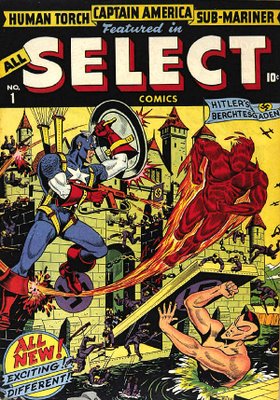
In 1963 I bought a copy of All Select Comics #1. I bought it sight unseen through the mail. In those days no one published reproductions of covers, unless it was to trace them off on stencils for a spirit duplicator. Xerox machines were very uncommon, and photo-offset printing of a fanzine with something as eclectic as old covers would have been prohibitively expensive. So I had never seen the book and didn't know what I was in for when I opened the package.

For full-size image click here.

I was floored by the cover. I was in awe of the drawing, the activity going on, the giant figures of the super heroes. However, awesome turned to awful when I looked at the contents, which as I remember were a hurried and amateurish looking comic shop job. By the time this came out in the summer of 1943 all of the great artists were in the Army, I'm sure. I sold the book a year later for $4.75. Ouch.

A couple of years later I was in Berchtesgaden and visited what was called "Hitler's Tea Room," for lunch. I thought about this cover, wondering what the Germans around me would have thought if they'd seen it.

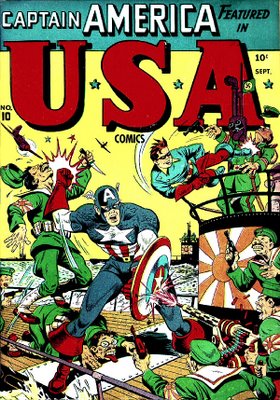
Schomburg gave equal time to the Japanese. The Timely superheroes were equal opportunity. They bashed everybody! While the Germans were depicted as stock caucasians, Japanese on the covers of comics fared poorly when depicted by any artist, not just Schomburg. They were usually so horribly caricatured that it's almost embarrassing now to look at them. Asians in general took a beating in comic book and comic strip art. They were either jug-eared, buck-toothed and goofy, or monkey-like in appearance. Racism against Asian races was rampant in America, and reared its head again during both the Korean and Vietnam conflicts.

For a full-size image click here.

I'm presenting this cover as an historical piece, not as any kind of agreement with its depictions of Japanese. And this was one of the milder Schomburg covers when it came to Japanese stereotypes.

Alex Schomburg was heavily in demand and did covers for several publishers. His drawing board must've been full of jobs during those war years. He usually did variations on a theme: some sort of sinister equipment, sometimes marked (Nipponese Earth-Boring Machine or some such nonsense), or as with the covers above, with swastika or Rising Sun prominent, and the heroes of that particular comic book publisher beating the snot out of the enemy. This was wartime with millions of men and women in uniform. Publishers just followed the trends and printed what at the time was morale-building and patriotic, and we should look at them as Americans did 60+ years ago, and not as how they look to us now.

Of the two covers, All Select #1 has to be one of my all-time favorite comic book covers by anyone, and I'm sure this issue flew off the stands when it appeared in 1943. The Overstreet Comic Book Price Guide describes it as "Classic Schomburg cover," and that would be a classic understatement.


More about →

Người đăng: vanmai yeu em on Thứ Ba, 1 tháng 8, 2006

Number 4

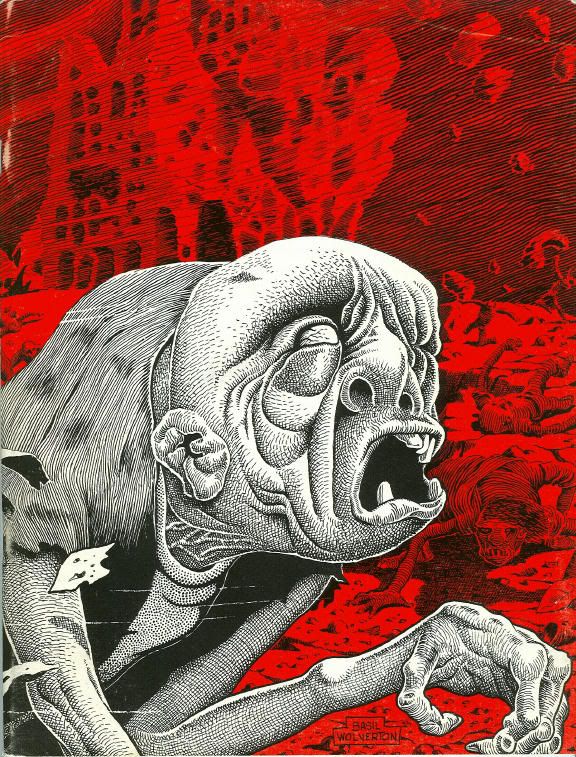
As a P.S. to my recent blog with the Basil Wolverton story, I'm adding this. The two issues of Graphic Story Magazine, #'s 12 and 14, that came out in 1970-71, were what opened my eyes to Wolverton's diversity as a cartoonist. Bill Spicer, the editor/publisher of Graphic Story Magazine, collected material from diverse places and people, and led to my understanding of Wolverton as both a respected cartoonist and also as a cult figure.

At the time of publication of the two issues of GSM Wolverton hadn't yet suffered his stroke and was creating covers for Plop!, a comic from DC, subtitled "The Magazine Of Weird Humor." Not too much of Plop! was all that humorous, weird or otherwise, but Basil's covers showed he was still as weird as ever, and as funny.

The two covers of Graphic Story Magazine show how much alike and how apart his art styles could be. They are both grotesque depictions of humans, but one is funny and how is gruesomely grim. That was Wolverton, and his work was instantly recognizable, no matter what genre he was drawing in at the moment.

For full-size image click here.


For a full-size image click here.

More about →

Lois Lane

Người đăng: vanmai yeu em on Chủ Nhật, 30 tháng 7, 2006

Lois Lane famously appeared alongside Clark Kent in Action Comics #1. In the early Superman stories, Lois appears to despise Clark, who loves her and longs to win her himself, although it quickly becomes apparent that she's more interested in Superman.

Lois earned a feature of her own right in Superman #28. Although the title of the feature may seem sexist to us now, "Lois Lane, Girl Reporter" was accurate at the time. Many newspapers had a "girl reporter" as something of a novelty--Nellie Bly being the most famous. The stories were generally four pages long and emphasized comedy over drama, much like the Alfred series that was printed in Batman around the same time.

In 1954, a Superman supporting character was given a solo book, but it wasn't Lois Lane or even editor Perry White. Rather it was Jimmy Olsen. Olsen had been a relatively minor character in the comic books up till that time. In fact, he was so minor that in Superman #72, a character looking exactly like the Silver Age Olsen appeared, as Perry White's son!

Of course, Olsen had been a much more significant character in both the Superman radio show and on television, which is the most probable reason for the sudden launch of Superman's Pal, Jimmy Olsen.

Lois didn't get her shot until Showcase #9, July-August 1957. She had one more tryout in the following issue, and in March-April 1958 Lois Lane #1 appeared on the newsstands. That issue also included the first artwork by the man who was to define Lois for the rest of the Silver Age, Kurt Schaffenberger.

Schaffenberger had drawn Captain Marvel back in the Golden Age, and he seemed to sense that Lois Lane needed to be slightly different from the ultra-serious Superman series. The covers often featured Lois or Superman in a particularly humiliating, yet comical situation, such as this:


The stories from this era are always a guilty pleasure. They have just the right amount of whimsical humor without quite dissolving into farce. A frequent theme had Lois being wooed by another man, either wealthy or powerful. Of course, Lois' goal was always to marry Superman, and there was a continuing "imaginary" series including the above story about the trials and tribulations of being married to the Man of Steel.
More about →

Người đăng: vanmai yeu em


Number 3

Basil Wolverton is on the Top 10 list of just about every fan of Golden Age comics because there wasn't anyone like him. Literally. At the beginnings of the comic book era Basil Wolverton seemingly sprang forth out of the forehead of the God of Mirth. Or the God of Nightmares.


As funny as Wolverton could be (and this episode of Bingbang Buster from Black Diamond Western #17, January 1950, is typical in that it is so funny), he could just as easily switch gears and draw some very unfunny and horrific visions, which he did for several memorable horror comics of the early 1950s.

What makes it even more remarkable is that he was also a religious person, who was an elder in The Worldwide Church of God, under its leader, evangelist Herbert W. Armstrong. He even went so far as to transfer his nightmare fantasies into several apocalyptic illustrations for his church's publications.

My introduction to Wolverton was like that of many others: I saw his work in Mad. His grotesque caricatures jarred me out of my complacency about what humorous illustration is or should be.

Wolverton's body of work was scattered around between many comic book companies, but luckily for us fans a lot of it--maybe all?--has been reprinted in one accessible form or another. Just look on eBay or Amazon.com under font-weight: bold;">Basil Wolverton.

Those of you with dial-up are in for a straight wait, Skate! Don't be in a fluster, Buster. Relax with some snacks.


More about →

Người đăng: vanmai yeu em on Thứ Sáu, 28 tháng 7, 2006


Number 2

Mother of Murderers


I want to thank Dr. Fredric Wertham for his 1954 book, Seduction of the Innocent, which introduced me to crime and horror comics. Thanks, Fred! Without your book seducing me, I don't think I would have searched out those sleazy old comic books. You turned straw into gold when you put out that book, mein herr.

Today's edition of Pappy's Golden Age Comics reproduces a classic story from Crime Does Not Pay #49, January 1947, by another Fred, artist Fred Guardineer. Guardineer was a Golden Age Comics pioneer…literally one of the first artist-stars of the early comic books. He retired in 1955 from comic books, but his old work still commands admiration from old-time comics fans. He had a great line style, very bold inking, with uncluttered designs and solid drawing. I have a copy of the fanzine Graphic Story World #2, from 1972, with a short article and photo of Fred. By the early '70s Fred Guardineer was drawing outdoor life pages for a paper called The Long Island Fisherman. He died in 2002.

This story, Mother of Murderers, is classic Crime Does Not Pay material. That comic book earned its reputation with stories like this, and Fred Guardineer didn't disappoint. Lots of gunplay, killings, all of the real fun stuff about crime comic books. Those of you with dial-up may want to go out and rob a convenience store* while these pages are downloading.

As a bonus, and I'll include these from time to time, is a classic ad from that same issue of Crime Does Not Pay. This is the infamous Kiss Me In the Dark, Baby tie.


I could never figure out how a guy wearing a tie that said Kiss Me in the Dark, Baby could actually get a girl in the dark so he could kiss her. If this worked for you let me know. I'm always looking for tips on how to get girls. Even a stud-muffin can use a new approach from time to time.

Until next time, stay happy! Pappy

*I'm only kidding, here. I do not want you sending your parole officer to my house to tell me to quit seducing the innocent.

More about →