Người đăng: vanmai yeu em on Thứ Hai, 25 tháng 9, 2006


Number 28


COVERING IT: Classic Golden Age comics covers.

Click on picture for larger image.


I can imagine the editorial conference that went on between editor and artist when this cover was dreamed up. "Al, I want some skeletons…two or three of 'em would be good. I need a girl chained to the wall, and a guy trying to get out who is being threatened by a skeleton coming out of a coffin. Oh yeah…try to work some spiders and lizards in there, too, would you?"

The "Al" the editor was talking to was Al Avison, one of the true workhorse artists of the Golden Age. He worked with Simon and Kirby on Captain America at Timely, then helped Syd Shores draw it when Simon and Kirby left to go to DC. He worked for various companies, but found his home at Harvey Comics, where he did a lot of stories, and a lot of covers. He could channel various artists, like Jack Kirby, Chester Gould, Ham Fisher, and so usually did the covers for issues of Dick Tracy or Joe Palooka when not doing a Kirbyesque Boy Heroes in All-New Comics.*

He did some fine horror comics, too, including this gem of a cover from Harvey's Chamber Of Chills #7,, dated April, 1952. One of the story titles on the cover, "Pit Of The Damned," would perfectly describe this illustration. If that isn't the damndest pit I've ever seen, I don't know what is.

I don't own this book. I found this picture on the Internet, and even though I thought I'd seen every cover of every Harvey horror comic I hadn't seen this one. It's eerie, with lots of elements that would seem really cool to a young boy picking it off the rack at the newsstand. "Wow! One of those skeletons has a knife through its skull! That is neat-o!"

This looks a lot like the sort of thing a young teenage boy might draw in his school notebook while sitting through another boring algebra class. In those days if the teacher saw it it probably wouldn't raise an eyebrow. He'd just think, "This kid reads too many comic books." Nowadays if a kid drew that picture and someone saw it he'd be in for a visit with a shrink. They'd think they had a potential serial killer on their hands.

Even for a 1952 horror comic this was pretty heady stuff, but if you look past the subject matter at the composition the elements are arranged in a pleasing way, and as with other Avison covers, there is so much going on that it is a classic of the era and of the genre.

*I will be showing a really nice Boy Heroes story sometime in the future. It's fun wartime stuff, and includes a vampire!

More about →

Người đăng: vanmai yeu em on Thứ Sáu, 22 tháng 9, 2006


Number 27

Frankenstein Friday: Frankenstein's Wife

This is the third story from Frankenstein Comics #1 from 1945, written and drawn by Dick Briefer.

The first two stories from the issue can be found in Pappy's Number 20 and Number 23.

This is a weird story--well, all of these Briefer Frankenstei
n stories are pretty weird--but this is weird even for Frankenstein, because sex rears its head. It's not explicit, just implied, but the statuesque, and toothsome Mrs. Frankenstein has some sort of sex appeal. Even more when the society gentlemen think she has $4,000,000.

Briefer was being original when he designed Mrs. Frankenstein (and no, she's not assigned a name except for that…something that Briefer did with supporting characters in many of his stories), because he didn't use the famous Elsa Lanchester Bride Of Frankenstein image to caricature. Rather than th
e beehive with lightning bolt design on The Bride's coiffure, Briefer put a Bettie Page hairdo on her head. You have to admit, Mrs. Frankenstein is pretty... ugh...unique.
I have read this story a couple of times over the years but I just noticed the note to the owner of the company Mrs. Frankenstein is quitting. The owner's name is W. C. Bowl, which would be Water Closet Bowl, or to us Yanks, Toilet Bowl. OK, it's not much of a joke, and its origin is probably in the experiences American GI's had in Britain during the war, but it must've appealed to Briefer's strange sense of humor.

Next week: Frankenstein and the Manimals!


More about →

Người đăng: vanmai yeu em on Thứ Tư, 20 tháng 9, 2006


Number 26


Ron Haydock's Sky Bird #1


Every once in a while I'll be departing from my usual Golden Age comics format to show you something from the fanzine days. I was on a comp list and used to get things like Sky Bird #1, posted here. They'd show up in my mailbox, and not many of them survived the periodic purges of my basement.

It's not strictly comics related, but I'll justify posting this by saying that Flash Gordon, the King Features comic strip of the 1930s by the artist, Alex Raymond, was the inspiration for not only the movie serial, but also influenced many of the earliest comic book artists of the golden age. How's that?

Science fiction and comic book fanzines, and especially the mimeo'd or ditto'd kind, were something like the Internet is today, only without the broad reach. I doubt Sky Bird #1 reached more than a hundred people, and probably more like fifty, which is about what a typical spirit duplicator stencil would last on a machine. What they were, more specifically, is freedom of speech. It was the right of anybody, anywhere, with access to a duplicator and a typewriter to make a stencil, to publish. That's what blogs are, many years later, just that sort of publishing, done in cyberspace instead of on 20-lb. duplicator paper. And of course, the potential to reach millions instead of a couple of dozen.

Author Sam Sherman takes an uncritical--what we used to call a "goshwow"--look at the old Flash Gordon serials, starring Buster Crabbe. Sherman lived in Hollywood and apparently knew Crabbe, who is quoted in this article.

Ron Haydock,who published this 4-page fanzine, was a very interesting character: rock singer, actor, writer. After his fanzine days he was the editor of a short-lived but entertaining magazine called Fantastic Monsters Of The Films.

By presenting this issue of Sky Bird, I'm giving it a potential audience unheard of by a fan editor in 1961, even someone who believed in the promise of a science fiction future like Flash Gordon's.


More about →

Người đăng: vanmai yeu em on Thứ Hai, 18 tháng 9, 2006


Number 25

Joe Kubert's "The Hog."

Joe Kubert is a cartoonist and teacher, as well as being one of the best comic book artists of all time. He started young, about 13, as an apprentice and he learned his lessons well.

Off the top of my pointy head, I can think of some of the Golden Age comic book publishers he worked for: DC, Harvey, St. John, and Atlas. He even did a short stint at EC, working with Harvey Kurtzman.

This story, The Hog, is from Journey Into Mystery #21, January 1955. It was the second to last issue of the pre-code series, and the whole comic seems somewhat tamer than earlier issues. Maybe the censorship talk was affecting them, even before the Comics Code went into effect.

The Hog is Horror Comics 101, the most basic style of horror story published in those pre-code years. A bad guy performs bad acts, and gets an ironic fate, brought about by his misdeeds. This story stretches that with the most laughable ending I've read, and you'll see what I mean when you read it.

Where it's great, and worth looking at, is in the artwork and storytelling style of Joe Kubert. The splash panel is a masterpiece, showing one car cutting off another car on a road with an S-curve. We're immediately dropped into the premise of the story: the main character is a jerk, a road hog. He's what police nowadays euphemistically call an "aggressive driver." In this case the guy likes to make people crash because he wants to see them die. Kubert's layouts are varied, and he uses his long shots with as much effectiveness as his close-ups. The last page is straight out of the Harvey Kurtzman stylebook.

Look also for the road sign that says "Drive Carefully" or the billboard with the "Reduce Tension" line for its gum ad. I doubt these were scripted in, but put in by Kubert for further irony.

A lesser artist would have taken such a ridiculous story with the very silly ending and by lack of talent made the story completely unmemorable. It's to Kubert's credit that no matter what story he was given to draw he made it worth a long look.


More about →

Người đăng: vanmai yeu em on Thứ Bảy, 16 tháng 9, 2006


Number 24


COVERING IT: Classic Golden Age Comics covers, Part 7


After World War II Alex Schomburg went from drawing superheroes beating up our foreign enemies to beating up our domestic enemies. He drew some mighty sexy girls, too.

This cover of Black Terror #20 from 1947 is a great example of what I'd call the VaVa Voom factor; guys seeing this cover on the newsstand would just naturally reach for their dime. Sex appeal was great on post WWII covers, especially prevalent with the crime comics of the era, but also available on even the teenage titles like Al Feldstein's Junior or even the venerable Archie.

I have read some of the Black Terror stories, and frankly, the covers needed to be hot to sell those books.

Schomburg worked in a couple of different styles, ink and airbrush. He either signed his work with his real name or as Xela. No matter what medium he worked in, what his subject matter was, no matter what name he used his covers were extremely well drawn and eye-catching. This is probably one of his top sexy covers.


Click on picture for larger image.

More about →

Amazing Spiderman #46-47

Người đăng: vanmai yeu em

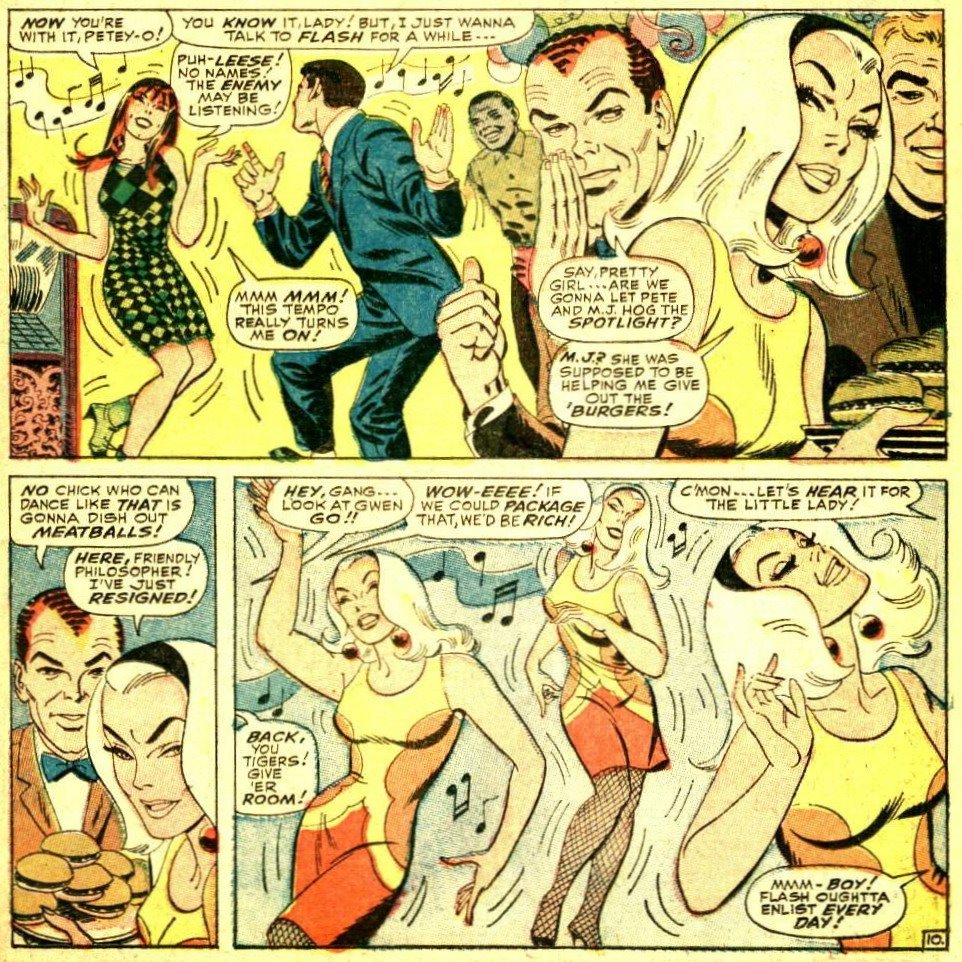
ASM #46 starts rather abruptly. Spidey, his arm still in a sling from his battle with the Lizard in #44, encounters the Shocker, a guy with special vibrating gloves which give him extraordinary power. He kayos Peter and gets away.

The next big event in Peter's life comes later. Harry Osborn's dad has rented an apartment for him close to Empire State U. He invites Peter to take the second bedroom. Of course, our hero is thrilled at the prospect, but has to figure out whether it would be an inconvenience to Aunt May. Fortunately, she has already decided to move in with Anna Watson, so for once things seem to be breaking Peter's way. At this point he appears to be casually dating Mary Jane, but Gwen is starting to interest him more.

Spidey handles the Shocker in their second battle by not allowing the crook to use his thumbs on the vibrating gloves. Some modest pop culture and political references; Spidey mentions Hubert Humphrey and The Man from UNCLE. Still, we get some inevitable teenage angst here:


Kraven returns in #47, as well as (briefly, in flashback) the Green Goblin. We learn that Gobby had hired Kraven to attack Spiderman in ASM #34, something that was not disclosed at that time. In addition, Norman Osborn himself (aka the Green Goblin) had acted as a go-between, exposing himself as a crook to Kraven.

Kraven has developed a new ray that will eliminate Spidey's super-speed, and is confident once that is gone he will be able to subdue Webhead. We get a long dose of the Archie stuff:


But eventually the battle starts. Kraven decides to kidnap Harry, who's with Peter at a going-away party for Flash Thompson, who's been drafted into the army as discussed in earlier issues. Peter sneaks away and reappears as Spiderman. He taunts Kraven into dropping Harry and they fight. This time Kraven defeats him with his ray, but stops short of killing him when Norman Osborn shows up. However Kraven is baffled when his jungle senses tell him that Osborn doesn't remember him at all. Of course, he had no way of knowing that Osborn has amnesia about his Green Goblin years. Kraven decides that his victory over Spiderman is enough and dashes off.
More about →

Người đăng: vanmai yeu em on Thứ Sáu, 15 tháng 9, 2006


Number 23

Frankenstein Friday: Frankenstein And The Ghouls And Vampires.
"I want a ghoul, just like the ghoul, that buried dear old dad!" Ah, excuse me…just warbling a tune, Sinatra-style, in honor of this edition of Frankenstein Friday.

As promised, here is the second story from Frankenstein Comics #1, from 1945, written and drawn by Dick Briefer. As listed in The Overstreet Comic Book Price Guide, Frankenstein Comics #1 is noted for two things: The origin story and for the Sinatra parody, which appears in this story.

It isn't much of a parody, and the jokes surrounding the parody are pretty lame. As a matter of fact, the whole story is fairly lame, but Briefer's cartooning and bizarre sense of humor save it. Horror comics as we know them were still a couple of years away when Briefer drew this story, but his depictions of the ghouls and vampires could be slightly less cartoony and fit right in a horror story of the 1950s. In that way Briefer was ahead of his time.

In other news, Frankenstein's weight changes drastically in this story, thanks to a potion he creates, which I don't believe was ever seen again in any other Frankenstein story. The color of his coat on one page switches from blue to red from panel to panel. That wasn't Briefer's fault, since coloring for Golden Age comics was usually handled by an outside company and coloring inconsistencies abound in many titles. There were thousands of pages of comics published every month, hard for anyone not to make some mistakes.

Finally, I don't know if there was ever any other comic book story in which the bad guys were conquered by a belch.

NEXT WEEK: Frankenstein's Wife!


More about →