But Dial B for Blog, which is always terrific, has a superb series on Ira Schnapp. Who was Ira Schnapp? One of the most important men in the history of comics. This is highly recommended!
More about →
Người đăng: vanmai yeu em on Thứ Hai, 9 tháng 10, 2006

Number 35
Bob Powell's Shrunken Skull!
In Pappy's Number 34 I showed you a Bernard Baily shrunken head cover. Now I'm showing you one of my favorite Harvey Comics horror stories, The Shrunken Skull, drawn by the great Bob Powell. It appeared in Chamber Of Chills #5, February, 1952.
Powell, born in 1916, was an old-timer at the comic book business by the time of the horror comics explosion of the 1950s. In the early 1940s he had worked for Will Eisner on The Spirit Section doing Mr. Mystic. He had worked for virtually every comic book company at one time or another. In the 1950s he ran a comic book production shop. His work appeared in all genres of comics for several clients, but I believe his main clients at the time were Harvey and M.E., with a lot of work also going to Fawcett and St. John.
What characterized Powell's work was quality. I don't think he ever let a job out of his hands until it was refined to perfection. If it took a gallon of white paint to correct mistakes, then so be it! I have seen original art of his that looks to be half ink, half white paint. I don't know how he worked, or what exactly his assistants did, but Powell signed the pages, and the work is so distinctive I believe he had a lot to do with the actual drawing, or at least the inking.
To show you, I'm including a scan of the original art for the splash page to The Shrunken Skull. You'll notice the light blue watercolor wash on the artwork. That did not reproduce when photographed by the lithographer's camera during production, but was an indicator to the color artist of what areas of the artwork were to be emphasized with color. If any other artists used this technique I'm not aware of it, but you can compare the original art to the published art and see if it worked.
It's also to Powell's credit that he could take a story as screwy as this and through such fine art make the story work. Most horror stories have crazy plots…this one a little crazier than most.
In the future I will have episodes of what I think was Powell's 1950s magnum opus, Jet Powers. I own all four issues of that M.E. science fiction title. So far I have scanned the first issue for inclusion on this blog at some point.
But that's in the future, and right now it's October, Halloween month. Outside the sky grows dark, and the wind is chilly. Leaves blow across the lawn. Jack O'Lanterns with their gappy grins are winking at you from porches as you walk the unlit sidewalks, pulling your coat tighter around you. It's time to read some horror stories. Time for The Shrunken Skull!


Người đăng: vanmai yeu em on Chủ Nhật, 8 tháng 10, 2006

Number 34
COVERING IT: Classic Covers Of Golden Age Comics
Click on picture for larger image
."Hey Rocky! Watch me pull a rabbit outta my hat!"
"Hokey smokes, Bullwinkle! That's no rabbit! It's a head! A decapitated, shrunken head!"
Ah yes, cartoon-lovers and friends…welcome to Pappy's, where we consider nothing too gruesome, gory or gross to be shown to our pals.
This cover of Weird Mysteries #6 from 1953 reminds me of the story of EC Comics publisher William Gaines in front of the Senate subcommittee investigating comic books and juvenile delinquency. When they pulled out the famous Johnny Craig Crime Suspenstories cover with the decapitated head Gaines was asked, "Do you consider this to be in good taste?" to which he replied, "Yes, for a horror comic."*
Gaines' argument as to what would make the cover in bad taste would be if it had shown the neck dripping with blood. We get that here in this cover by the redoubtable Bernard Baily, whose covers likely caused a few nightmares amongst comic book readers, but apparently no Senate committee members.
You last saw a classic Bernard Baily cover in Pappy's Number 31. Another classic!
*I don't have the exact quote in front of me so I'm paraphrasing. The exact testimony is available in several places but I don't have the time or energy to look it up. So sue me. Just go to behead-all-lawyers.com.
"Imaginary" Stories
Người đăng: vanmai yeu em
In the early 1960s, Mort Weisinger, the editor of the Superman line of comics (including Action, Adventure, Superman, Jimmy Olsen, Lois Lane, and World's Finest) began to allow his writers to script what were called "imaginary" adventures. Of course, all superhero comics are "imaginary", but these stories allowed the writers to break some of the rules that were required with such successful continuing characters. We could see what might happen if Lois Lane married Superman (or Lex Luthor) while the next issue could completely ignore that wedding, because it had been clearly labeled an imaginary story.
I suspect in some ways this was an outgrowth of the way DC's comics of the early 1960s often featured what I call a "puzzle" cover. The puzzle was "Why is this happening?" For example, suppose the cover showed Jimmy Olsen doing something particularly nasty to Superman, like the following:
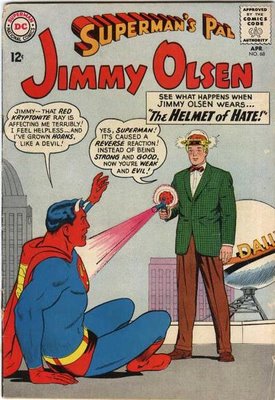
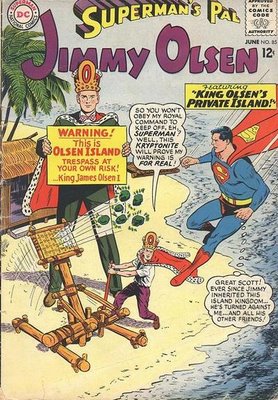
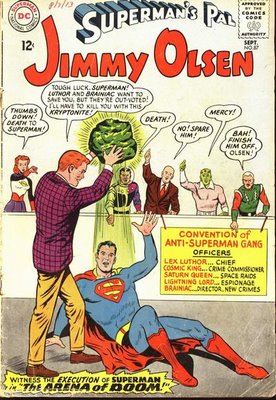
The last one even offers a double puzzle since not only is Olsen betraying his friend, but Brainiac and Luthor, Superman's worst enemies, are pleading for his life.
Anyway, the point is that DC loved these puzzle covers and so apparently did their readers. But of course it became tougher and tougher for the writers to create situations that managed to not only create a great puzzle cover, but which ended with everybody unchanged essentially. Hence the imaginary stories.
The concept has proven irresistable. Marvel published hundreds of "What If" issues and DC has its "Elseworlds" line; both are clearly inspired by the "Imaginary" stories. Of course you can track imaginary stories back to dream stories; the difference is that you don't have the falling asleep and waking up scenes.
I believe (but I'm not sure) that the first "Imaginary" story billed as such was "The Death of Superman" in Superman (V1) #149, November 1961. This is one of the most famous Superman stories of all time because it does not cop out at the end; Superman dies and Supergirl (until then still unknown) must carry on her cousin's tradition. (Correction: As noted in the comments, the first imaginary story is "Mr and Mrs Clark (Superman) Kent" from Lois Lane #19, August 1960).
In the story, Luthor convinces the world and Superman that he's reformed by finding a cure for cancer, then ambushes his longtime opponent and kills him with Kryptonite. Supergirl apprehends him (much to his dismay), but Luthor thinks he can escape the death penalty because he knows how to expand the bottle city of Kandor, where the trial is taking place, to normal size. However the Kandorians demand justice and Luthor is sentenced to the ultimate penalty.
There were some terrific "Imaginary" stories; "The Story of Superman Red and Superman Blue" in Superman #162, "Jor-El II and Kal-El II" from Superman #166, and "Clark Kent's Brother" in Superman #175 were all excellent three-part tales that explored Superman's character in new ways that would not have been possible otherwise.
Unfortunately, the great stories did not come without a price. Some stories which created bad characterization would be undone by the explanation that "it was an imaginary story". For example in Superman #205 (April 1968), it was disclosed that a heretofore unknown villain named Black Zero had actually destroyed Krypton. Jor-El was wrong, the planet would not have exploded without Black Zero to restart the nuclear reaction.
This of course was horrific characterization for Jor-El, who was God the Father in the DC universe in those days and the story was kicked under the carpet. In a similar fashion, DC explained in Flash #167 that Barry Allen had not been hit by chemicals and lightning by accident in Showcase #4; rather he'd been blessed by a Guardian Angel. Exit Guardian Angel stage left.
For the most part the "Imaginary" stories were confined to Superman, but a couple crept over to Batman via the World's Finest title, so we saw what would happen if Bruce Wayne had been adopted by the Kents. In an influential pair of stories, DC tried an imaginary look at Superman and Batman's sons in World's Finest #154 and 157. Amusingly, forced to come up with a wife for Batman, Weissinger chose Kathy Kane aka Batwoman, who had been retired from Batman for about two years.
No DC stories of the Silver Age that did not prominently feature Superman were billed as imaginary at the time, although they have been retconned to that status.
More about →
I suspect in some ways this was an outgrowth of the way DC's comics of the early 1960s often featured what I call a "puzzle" cover. The puzzle was "Why is this happening?" For example, suppose the cover showed Jimmy Olsen doing something particularly nasty to Superman, like the following:


The last one even offers a double puzzle since not only is Olsen betraying his friend, but Brainiac and Luthor, Superman's worst enemies, are pleading for his life.
Anyway, the point is that DC loved these puzzle covers and so apparently did their readers. But of course it became tougher and tougher for the writers to create situations that managed to not only create a great puzzle cover, but which ended with everybody unchanged essentially. Hence the imaginary stories.
The concept has proven irresistable. Marvel published hundreds of "What If" issues and DC has its "Elseworlds" line; both are clearly inspired by the "Imaginary" stories. Of course you can track imaginary stories back to dream stories; the difference is that you don't have the falling asleep and waking up scenes.
I believe (but I'm not sure) that the first "Imaginary" story billed as such was "The Death of Superman" in Superman (V1) #149, November 1961. This is one of the most famous Superman stories of all time because it does not cop out at the end; Superman dies and Supergirl (until then still unknown) must carry on her cousin's tradition. (Correction: As noted in the comments, the first imaginary story is "Mr and Mrs Clark (Superman) Kent" from Lois Lane #19, August 1960).
In the story, Luthor convinces the world and Superman that he's reformed by finding a cure for cancer, then ambushes his longtime opponent and kills him with Kryptonite. Supergirl apprehends him (much to his dismay), but Luthor thinks he can escape the death penalty because he knows how to expand the bottle city of Kandor, where the trial is taking place, to normal size. However the Kandorians demand justice and Luthor is sentenced to the ultimate penalty.
There were some terrific "Imaginary" stories; "The Story of Superman Red and Superman Blue" in Superman #162, "Jor-El II and Kal-El II" from Superman #166, and "Clark Kent's Brother" in Superman #175 were all excellent three-part tales that explored Superman's character in new ways that would not have been possible otherwise.
Unfortunately, the great stories did not come without a price. Some stories which created bad characterization would be undone by the explanation that "it was an imaginary story". For example in Superman #205 (April 1968), it was disclosed that a heretofore unknown villain named Black Zero had actually destroyed Krypton. Jor-El was wrong, the planet would not have exploded without Black Zero to restart the nuclear reaction.
This of course was horrific characterization for Jor-El, who was God the Father in the DC universe in those days and the story was kicked under the carpet. In a similar fashion, DC explained in Flash #167 that Barry Allen had not been hit by chemicals and lightning by accident in Showcase #4; rather he'd been blessed by a Guardian Angel. Exit Guardian Angel stage left.
For the most part the "Imaginary" stories were confined to Superman, but a couple crept over to Batman via the World's Finest title, so we saw what would happen if Bruce Wayne had been adopted by the Kents. In an influential pair of stories, DC tried an imaginary look at Superman and Batman's sons in World's Finest #154 and 157. Amusingly, forced to come up with a wife for Batman, Weissinger chose Kathy Kane aka Batwoman, who had been retired from Batman for about two years.
No DC stories of the Silver Age that did not prominently feature Superman were billed as imaginary at the time, although they have been retconned to that status.
Người đăng: vanmai yeu em on Thứ Sáu, 6 tháng 10, 2006

Number 33
Frankenstein Friday: Your Name Is Frankenstein!
Stan Lee once said of Joe Maneely, "He could draw anything." Maneely was a staple of 1950's Atlas Comics, doing horror, mystery, westerns, science fiction, even a continuing character called The Black Knight. He had an interesting pen style, and was said to be fast enough to draw and ink seven pages in one day.
Regardless of the speed, Maneely was very good, and could strike a dramatic mood in the stories he was handed to draw. "Your Name Is Frankenstein," from Menace #7, is a good example of Maneely's pen work, his dramatic staging, and solid drawing.
Maneely died of an accident at age 32 in 1958. It's fun to speculate what he could have meant to comics had he lived. Would he have been part of the Marvel Comics of the 1960s? I haven't ever seen any superhero work by him, but don't doubt that he could probably draw them as well as anyone.
Unfortunately, my copy of this story is in terrible shape, with holes in some of the pages and the residue of years-old Scotch tape, which has left brown stains (a really good lesson in how not to take care of your Golden Age comic books).
Even though I consider this to be one of the better stories in that particular issue of Menace, apparently the editor didn't feel it warranted inclusion in the blurbs on the cover, which show every other story but this. It might have been a late addition to the lineup.


Người đăng: vanmai yeu em on Thứ Tư, 4 tháng 10, 2006

Number 32
Bizarre Boody Rogers
I'm not sure, but I think Boody Rogers might have been chewing peyote buttons in his native Texas while drawing most of his really bizarre comic strips. He was the creator of Sparky Watts, "World's Strongest Funny Man," and Babe, Darling of the Hills. There is an hallucinogenic quality to his work.
Rogers started out as assistant to Zack Mosley on Smilin' Jack, where he learned to draw girls. Smilin' Jack called them "de-icers," and they certainly could melt any man with their curvy bodies and accentuated bottoms.
Rogers is dead now, but quit cartooning many years before he died. His heyday was in the 1940s, and especially the postwar era. Sparky Watts was published every month in 6-page installments in Big Shot Comics and his irregularly published solo comic book, Sparky Watts, which went 10 issues.
An especially appealing and strange strip is his Babe, a Li'l Abner imitation, which went 11 issues in the late 1940s.
Put "Boody Rogers" in Google and see what comes up. Several people have posted some nice strips that show how wonderfully bizarre was Boody!
This is the middle of a story, this episode originally published in Big Shot Comics #86 about some really oddball little characters. I don't have the previous or next episodes.
The more people get into Boody Rogers the more they appreciate the really whacked-out humor of his comic strips. Artwise he doesn't really remind me of anyone except Zack Mosley, but his stories were original, on a level with Basil Wolverton's Powerhouse Pepper, Dick Briefer's Frankenstein, or Bill Holman's Smokey Stover. Someday someone may collect all of the really screwball work that Boody Rogers left behind in 1952 when he opened some art supply stores in the Southwest and dropped his cartooning.


Amazing Spiderman 48-49
Người đăng: vanmai yeu em on Thứ Ba, 3 tháng 10, 2006
In Amazing Spiderman #48, Marvel did something rather interesting. They replaced an aging villan (the Original Vulture) with a newer, updated version. Blackie Drago was the cellmate of the OV, and has been pestering him for the secret of his wings. The Vulture, facing death as a result of a machine shop accident, decides to divulge the hiding place of a pair just outside the prison walls.
At this point Blackie laughs and reveals that he was responsible for the accident which injured the Vulture. He wastes little time in breaking out of prison and once he has the wings he seems to be invulnerable, especially since our friendly neighborhood Spiderman is coming down with a cold.
The story comes to a climax atop a bridge, with a hostage and Spidey facing an enemy who can fly. This time, however, the hostage is a nobody and thus does not die. Eventually the new Vulture manages to defeat Spidey, helped a great deal by the latter's illness.
There are a few examples I can think of where an old villain was replaced by a new one in the GA and SA. For example, Batman's old nemesis Two-Face came back as two different people before Harvey Dent himself resumed the role at the very end of the Golden Age. Still, it was not common as of 1967, when this story first appeared, although of course in modern comics there are many examples of crooks retiring and others (sometimes related, sometimes not) taking over their names.
Another interesting aspect to the story is that it's plainly set in the winter in New York, and the weather plays a key role in the story.
In ASM #49, Kraven reappears. Jealous that the Vulture has gotten attention by defeating Spiderman, he resolves to attack Drago. Meanwhile, Peter is still sick and recuperating in bed. Aunt May stops by and insists on calling Dr Bramwell, the family doctor. While Peter is waiting to see him, and starting to feel much better, he learns that Kraven and the Vulture are tearing up the city. So he joins the battle and this time manages to decoy Kraven into kayoing the Vulture before he removes the former's ray gun that so devastated Peter in ASM #47.
More about →
At this point Blackie laughs and reveals that he was responsible for the accident which injured the Vulture. He wastes little time in breaking out of prison and once he has the wings he seems to be invulnerable, especially since our friendly neighborhood Spiderman is coming down with a cold.
The story comes to a climax atop a bridge, with a hostage and Spidey facing an enemy who can fly. This time, however, the hostage is a nobody and thus does not die. Eventually the new Vulture manages to defeat Spidey, helped a great deal by the latter's illness.
There are a few examples I can think of where an old villain was replaced by a new one in the GA and SA. For example, Batman's old nemesis Two-Face came back as two different people before Harvey Dent himself resumed the role at the very end of the Golden Age. Still, it was not common as of 1967, when this story first appeared, although of course in modern comics there are many examples of crooks retiring and others (sometimes related, sometimes not) taking over their names.
Another interesting aspect to the story is that it's plainly set in the winter in New York, and the weather plays a key role in the story.
In ASM #49, Kraven reappears. Jealous that the Vulture has gotten attention by defeating Spiderman, he resolves to attack Drago. Meanwhile, Peter is still sick and recuperating in bed. Aunt May stops by and insists on calling Dr Bramwell, the family doctor. While Peter is waiting to see him, and starting to feel much better, he learns that Kraven and the Vulture are tearing up the city. So he joins the battle and this time manages to decoy Kraven into kayoing the Vulture before he removes the former's ray gun that so devastated Peter in ASM #47.


