Living On Borrowed Time

Người đăng: vanmai yeu em on Thứ Ba, 17 tháng 10, 2006

That was the schtick of the Challengers of the Unknown. Ace Morgan, a test pilot, Prof Haley (Hale in #1), a skindiver, Red Ryan, a circus daredevil, and Rocky Davis, an Olympic wrestling champion. After they survive a plane crash unhurt, they decide to band together and take on dangerous assignments because, after all, they shouldn't rightly be alive anyway.

The series marked the (brief) return of Jack Kirby to DC Comics. Kirby had been influential with DC in the early 1940s, creating several long-running series like Boy Commandos (originally a Detective Comics backup strip, who later expanded into their own book which lasted a full 36 issues and the Newsboy Legion, who held down the lead feature in Star Spangled Comics for several years.

The Challengers first appeared in Showcase #6, the Jan-Feb 1957 issue. They made three more appearances in #7, #11 and #12, before graduating to their own title in Apr-May 1958. They were the second feature to make the jump from Showcase to headlining a magazine after Lois Lane, but before the Flash.

One of the more interesting facets of the Challengers was that they started out with book-length tales. This was unique for DC comic books of the time, which always had at least two stories and usually had three. Kirby broke the stories into four parts and had splash panels on each part, very much like what he would do with Fantastic Four a few years later. Oddly enough, though, when the series moved into its own title there were generally two stories in each issue.

June Walker (later June Robbins), a highly regarded young scientist was an honorary Challenger. Of course, like many other DC features the Challengers would eventually attract a bunch of subsidiary characters.

The Challengers initially had rather bland purple uniforms that basically looked like a sweatsuit, although that would change twice before the Silver Age was finished. They went to an ugly yellow and red combination with an hourglass (symbolizing borrowed time) in Challengers of the Unknown #43, then to back to purple suits with yellow striping on the arms and legs in #70, one of the last original issues.

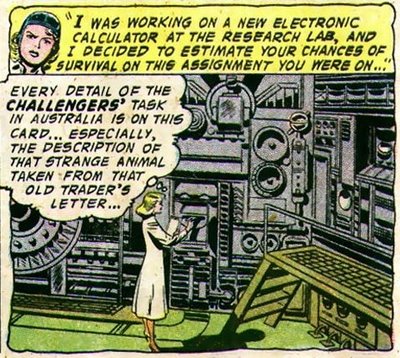
One interesting facet of the early Challengers was the use of "modern" science. In Challengers #1, a Dr Evil-type steals a rare transistor. In #2, we see what a good calculator looked like back in 1958:


The series was edited by Jack Schiff, and as with all Schiff's titles suffered from a surfeit of monsters, dinosaurs and weird transformations.
More about →

Người đăng: vanmai yeu em


Number 40


Charlie Biro's Hobby Is Boys

Click on picture for full-size image.


This page, taken from Boy Comics #30,October, 1946, is a good example of how language changes.

Charles Biro was a popular guy in the 1940s. He made publishers a lot of money with his covers, his characters, and his comic books. He's responsible for many, including the original Daredevil, Airboy, and probably his biggest success story, Crime Does Not Pay. He also had a very popular title, Boy Comics, which ran for years,

In Boy Comics #30, co-editor Bob Wood writes of Biro, "Boys are his hobby." Sixty years ago that wasn't the loaded statement it is now, what with stories of former Congressman Mark Foley filling the news and radio talk show rants.

The language has changed, and so descriptions of Biro having "tongue-fests," or "getting the biggest rise" out of boys didn't mean to readers of the era what they look like to readers of our era.

According to some reports I've read about Biro (who died in the early 1970s), he was a guy who had a lot of success with women. On the other hand, Bob Wood, his aforementioned co-editor, was a guy who apparently liked to hit women, and it cost him a prison sentence in the 1950s when he killed one during a drunken binge.

Crimebuster himself was a character I never particularly liked, although I have several issues of the comic in my collection. Any youngster who puts a cape over a hockey uniform and runs around with a monkey named Squeeks, well…I dunno…the whole premise sounded pretty stupid to me. To a lot of kids it must've seemed great, because Boy Comics, starring Crimebuster, was a good-selling comic book.

One thing came out of Boy Comics, and that was one of the all time great comic book villains, Iron Jaw, the guy with the metal dentures. Language has changed enough that nowadays "he'll bite your head off" doesn't mean literally biting a head off, as Iron Jaw was known to do.


More about →

Người đăng: vanmai yeu em on Thứ Hai, 16 tháng 10, 2006

Number 39


Mark Foley's Comics Pages
As soon as I heard about Congressman Mark Foley's resignation because of impropriety toward Congressional pages I remembered an old issue of Treasure Chest with a story about page boys who work in the Capitol. This is
from Treasure Chest Of Fun and Fact, Volume 18 Number 12, February 14, 1963.

Treasure Chest, for those who don't know, was a comic book distributed during the school year to Catholic schools. What issues I've seen or owned I've found a bit pedantic. There was this notion, when it was started in 1946, that despite their popularity comic books were bad for kids, and adults, too. This was a way of getting kids to read about so-called healthier subjects in a format they liked.

Joe Sinnott, who is probably most famous for his inks on Jack Kirby's Marvel work of the 1960s, did the artwork. At that time Sinnott was not only inking Kirby's Fantastic Four, but drawing comic books like the life story of The Beatles for Dell, or doing stories for Treasure Chest. Sinnott worked in many genres of comics over the years, from some spooky horror stories for Stan Lee in the early '50s, to this more prosaic work in the 1960s and beyond.

Treasure Chest lasted from 1946 until 1972. A decent run for any comic book with a non-specific theme.


This story ends abruptly on page 5. Page 6 was probably drawn, but cut during the editing process; maybe the issue was one page too long. The last panel of the published story seems to leave things hanging a bit, but the story gets its point across.

In that more innocent era, the page boys are more concerned about girls someday becoming pages (horrors!) than they are about chickenhawk Congressmen lusting after them.

And as for Representative Mark Foley, I guess he thought pages were for turning.

Click on the pictures for full-size images.

Page 1.


Page 2.


Page 3.


Page 4.


Page 5.


More about →

Dr Strange Part II

Người đăng: vanmai yeu em on Chủ Nhật, 15 tháng 10, 2006

Dr Strange returned in Strange Tales #111. This story introduces his arch-rival, Baron Mordo. Mordo is another former student of the Master, the Tibetan monk who taught Dr Strange the Mystic Arts. His ecoplasmic form compels the Master's servant to poison him, and hectors the Master to give him all his secrets if he wishes to remain alive. Fortunately Dr Strange arrives and saves the day. This is a very short story (only five pages), and the last Dr Strange for a few issues.

Dr Strange returns in Strange Tales #115, in "The Origin of Dr Strange". Stephen Strange (the first we learn his given name) was a skilled but arrogant and money-hungry surgeon. A car accident leaves the nerves in his hands damaged and he becomes a drifter. When he hears of a man who can supposedly cure anyone, he seeks out the Master in Tibet. However, the Master is not willing to help him because his motives are selfish, but he does offer to tutor Strange in the magic arts.

Strange is introduced to the Master's other pupil, Baron Mordo. Mordo is trying to kill the Master. Mordo casts a spell preventing Strange from warning the Master of his danger. Strange realizes that in order to defeat Mordo, he must learn black magic himself.

The next appearance is in Strange Tales #116. Dr Strange faces the villain from the first story, Nightmare, who has worked out a way to bring sleeping humans into the dark world he inhabits.

Ditko's artwork is again perfect for the moody, mystical story:


Dr Strange manages to rescue the sleeping men from the clutches of Nightmare, but not without considerable risk to himself.

This was also the last issue of Strange Tales not to feature at least a mention of the Dr Strange story on the cover.

For the previous Dr Strange post, click here.
More about →

Người đăng: vanmai yeu em on Thứ Bảy, 14 tháng 10, 2006

Number 38


COVERING IT: Classic Golden Age Comics Covers


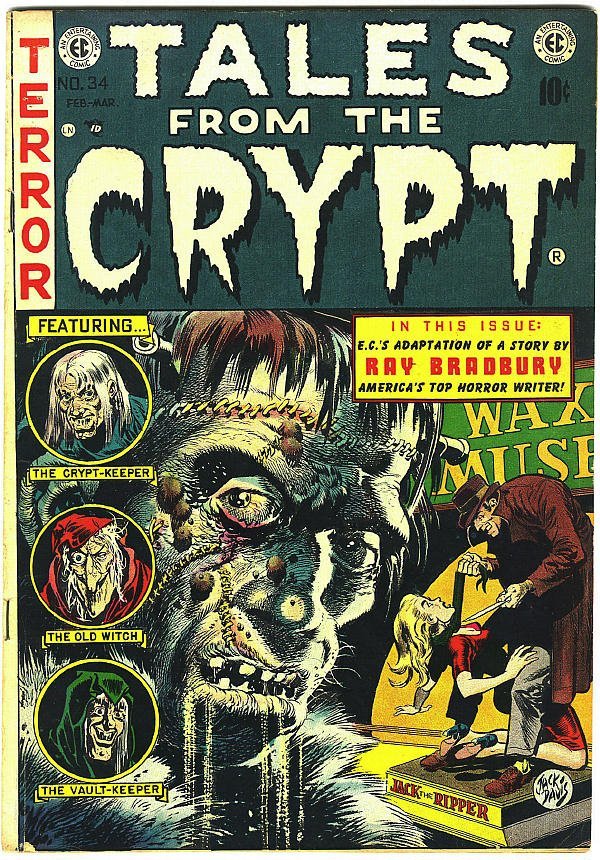
At EC Comics Jack Davis was a great amongst greats. It turned out that he probably had more commercial success after the crash of the original EC line, because he could draw absolutely anything. During the run of EC his distinctive style stands out, even amongst his talented peers, especially on covers of Tales From The Crypt.


Click on pictures for larger images

Davis took over the cover assignments from Al Feldstein, whose art was kind of stiff, but poster-like; perfect for covers. Davis added a touch when he brought his dynamic, action-filled art to the covers and they popped off the newsstands.

During that run as cover artist, Davis did three classic monster covers in a row. Tales From The Crypt #34 features the Frankenstein monster, #35 a werewolf, and #36 is a vampire. So I'm showing them all to you here.

In 1970 super-Golden Age comics fan Tom Fagan told me he thought Davis's cover of #35 was "the greatest werewolf cover ever." I wouldn't dispute that then or now. No matter what the subject matter, humor, horror, you name it…the tall guy from Georgia could draw it.

More about →

Người đăng: vanmai yeu em on Thứ Sáu, 13 tháng 10, 2006


Number 37


Frankenstein Friday: Frankenstein and the Statue Maker!


It's Friday the 13th, gang. Everybody watch out for ladders crossing their paths, and don't walk under any black cats.

This Friday's Frankenstein begins issue #2 of Frankenstein Comics, written and drawn by Dick Briefer, originally published in 1945.

The story begins with a 4-page recap of issue #1, and then goes into one of Briefer's longer Frankenstein stories, Frankenstein and the Statue Maker. The villain, Scorpon, disrespected as a sculptor, finds a way to give his statues a very lifelike look.

I don't think the plot of a sculptor using real bodies as the basis of his art was new even in 1945, but this story may have influenced the movie, Bucket Of Blood, filmed on the cheap by Roger Corman in 1959. There was even th
e earlier movie, the first version of House Of Wax, starring Vincent Price, originally filmed for 3D release, that may have been inspired by this Frankenstein story. Who knows? Inspiration comes from different places.

The cover to Frankenstein Comics #2 is one of my favorite Golden Age covers. The large image of the monster combined with the bold use of primary colors gives it a poster like effect.

 Click on pictures for larger images.
Next Friday: Frankenstein's Job!


More about →

Người đăng: vanmai yeu em on Thứ Tư, 11 tháng 10, 2006


Number 36


Jack Cole and Silver Streak Part III


This story originally appeared in Silver Streak #6, September 1940, an issue called "scarce" in the Overstreet Comic Book Price Guide. The story was reprinted in the unnumbered Silver Streak, a one-shot published in 1946, reprinting the Silver Streak stories from issues 4-7 of the original comics series. That one-shot is the source of the scans of the story.

Prior stories from the one-shot comic are in Pappy's Number 6, and Pappy's Number 18.

This story presents some stereotyped Arabs, with racist overtones. The girl given to the sheikh for marriage is white, while the males are brown. This was a lot more common fictional device in those days before World War II. It was originally published 66 years ago, so I consider it an historical, pop culture look at people from other religions and countries, who were often stereotyped in pulp magazines, novels,
movies and even comic strips.

The Englishman is stereotyped also, but he's comic relief, not sinister, like the portrayal of the Arabs.

The Silver Streak episode is signed by "Ralph Johns," one of Cole's pseudonyms; the cover of Silver Streak #6 is signed by Cole using his own name. It doesn't depict Silver Streak, but The Claw, a racist portrayal of an Asian villain based on the then-popular idea of sinister "orientals", a la Fu Manchu.


More about →